
🧱 GlusterFS: Why It Was a Perfect Fit for SMBs and HomeLabs
For many years, GlusterFS filled a very specific and important niche:
distributed storage for small and medium-sized environments that did not have enterprise budgets, datacenter-class hardware, or massive network bandwidth.
It was never perfect. But it was practical. And in many environments, it was exactly the right tool.
With its deprecation and uncertain future, a gap has emerged – one that is currently not well served by existing alternatives.
This article explains:
- why GlusterFS worked so well for SMBs and HomeLabs
- why current alternatives fall short in these environments
- and why a new approach like QuorumBD is necessary
🧩 Why GlusterFS Worked So Well
GlusterFS succeeded not because it was cutting-edge, but because it was balanced.
What it did right:
- worked on consumer hardware
- tolerated low network bandwidth
- scaled reasonably from 3–10 nodes
- required no specialized hardware (like enterprise SSDs)
- was understandable and debuggable by humans
- integrated cleanly with Linux tools and filesystems
For HomeLabs and SMBs, this mattered more than raw performance or theoretical consistency guarantees.
A few practical examples:
- 1 GbE networks instead of 10–100 GbE
- SATA or mixed (consumer) SATA/NVMe instead of full enterprise NVMe fleets
- heterogeneous nodes instead of identical servers
- admins who also do networking, backups, and security – not full-time storage engineers
GlusterFS allowed all of that.
⚠️ The Problem After GlusterFS
With GlusterFS effectively discontinued, many users went looking for replacements.
What they found was frustrating:
most modern distributed storage systems assume enterprise conditions by default.
The result is a widening gap between:
- what SMBs & HomeLabs have
- and what modern storage systems expect
🧪 Comparing the Existing Alternatives
Below is a pragmatic comparison from the perspective of small clusters and non-enterprise environments.
🐙 Ceph (RBD / CephFS)
Ceph is powerful. No question.
But power comes at a cost.
Challenges for SMBs & HomeLabs:
- high operational complexity
- strong assumption of fast networks (10 GbE+)
- significant background traffic
- heavy memory and CPU usage
- painful to debug when things go wrong
- scaling down is not its strength
- enterprise hardware (like SSDs)
Ceph shines in large, homogeneous clusters with dedicated storage teams.
For a 3–6 node HomeLab on 1 GbE? It often feels like using a jet engine to power a bicycle.
💽 LINBIT DRBD / DRBD9
DRBD is solid and well-engineered.
But conceptually, it is replication, not distributed storage.
Limitations:
- typically active/passive or carefully managed active/active
- not object-based or scale-out in nature
- split-brain handling is complex and stressful
- scaling beyond a few nodes becomes operationally difficult
DRBD works very well for HA pairs.
It does not replace what GlusterFS offered as a scale-out filesystem.
🧊 Other Solutions (Longhorn, MooseFS, etc.)
Many alternative systems exist, but they usually fall into one of these categories:
- Kubernetes-centric and complex
- optimized for cloud-native workloads
- poorly documented edge cases
- assume fast networks and SSD-only storage
Again: not bad systems — just not designed for the GlusterFS audience.
🔍 The Core Problem Nobody Solves
The real issue is not technology.
It is assumptions.
Most modern distributed storage systems assume:
- high-bandwidth, low-latency networks
- identical nodes
- significant RAM and CPU headroom
- tolerance for operational complexity
SMBs and HomeLabs assume:
- 1 GbE networks (maybe 2.5 GbE at best)
- mixed hardware
- limited power budgets
- administrators who value predictability and clarity over raw throughput
GlusterFS aligned with the second group.
Nothing truly replaces that today.
🧠 Why QuorumBD Needs to Exist
QuorumBD is being developed specifically to fill this gap.
Not as a “Ceph killer”.
Not as an enterprise storage platform.
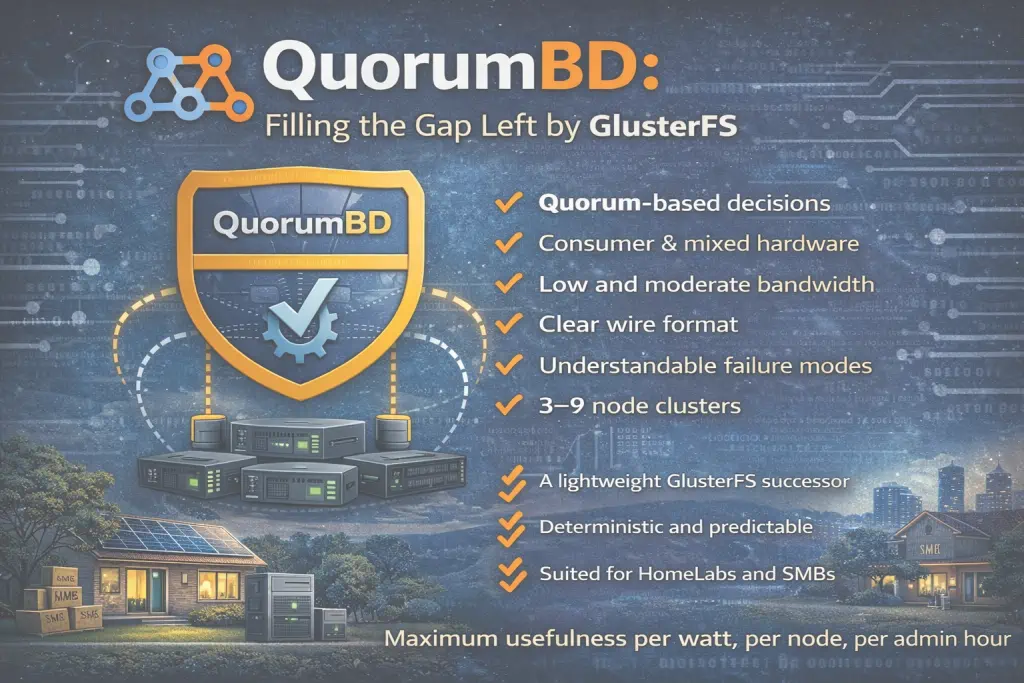
But as a lightweigthed GlusterFS successor in spirit, designed from the ground up for:
- small clusters (3–9 nodes)
- low and moderate bandwidth networks
- consumer and mixed hardware
- deterministic behavior
- understandable failure modes
- clear, documented wire formats
- strong consistency through quorum, not chatter
The goal is a performance at lease like GlusterFS even under heavy load.
The goal is maximum usefulness per watt, per node, per admin hour.
🔧 Design Philosophy (In a Nutshell)
QuorumBD is built around a few core ideas:
- quorum-based decisions instead of silent split-brain
- minimal background traffic
- predictable state machines
- explicit failure handling
- boring, transparent engineering over magic
- suitability for e.g. Proxmox clusters and HomeLabs
In other words:
a system that respects real-world constraints, not ideal lab conditions.
🌱 Looking Forward
The disappearance of GlusterFS leaves many users stranded:
- too small for Ceph
- too distributed for DRBD
- too practical for cloud-only tools
QuorumBD is currently developed because that space still matters.
Not everyone has a datacenter.
Not everyone wants Kubernetes everywhere.
And not everyone should be forced into enterprise assumptions just to get reliable shared storage.
Sometimes, boring, honest, and well-scoped engineering is exactly what is missing.